
The ROI of Gym Operations Intelligence

Introduction
Running a successful gym requires balancing several complex variables.
Operators must manage:
- member retention
- staffing efficiency
- facility capacity
- equipment investments
- programming schedules
- member experience
Traditionally, many of these decisions have been based on observation or intuition rather than data.
However, modern Gym Operations Intelligence platforms allow operators to analyze real operational activity across their facilities and turn that data into actionable insights.
The result is measurable business value — or return on investment (ROI).
From improved retention to better space utilization, Gym Operations Intelligence can significantly improve the financial performance of fitness facilities.
What Is Gym Operations Intelligence?
Gym Operations Intelligence refers to platforms that combine operational data, member behavior insights, and AI analytics to provide a complete view of how a gym operates.
These platforms analyze data such as:
- facility traffic patterns
- equipment usage
- peak-hour congestion
- member engagement trends
- zone utilization
Instead of guessing how their facilities perform, operators gain real-time visibility into the operational health of their gym.
Technologies like computer vision analytics help transform physical activity into measurable operational data.
➤ Learn more about Computer Vision for gyms
The Hidden Costs of Operating Without Data
Many gyms operate without comprehensive operational insights.
This can lead to several costly inefficiencies.
For example:
- overcrowded strength zones while cardio areas remain underused
- unnecessary equipment purchases
- inefficient staffing schedules
- poorly timed class programs
- member frustration due to congestion
We explored the broader industry data gap in:
➤ Why the Fitness Industry Is Behind in Data
Without accurate operational insights, gyms may unknowingly leave significant revenue and efficiency gains untapped.
See the ROI of Gym Operations Intelligence
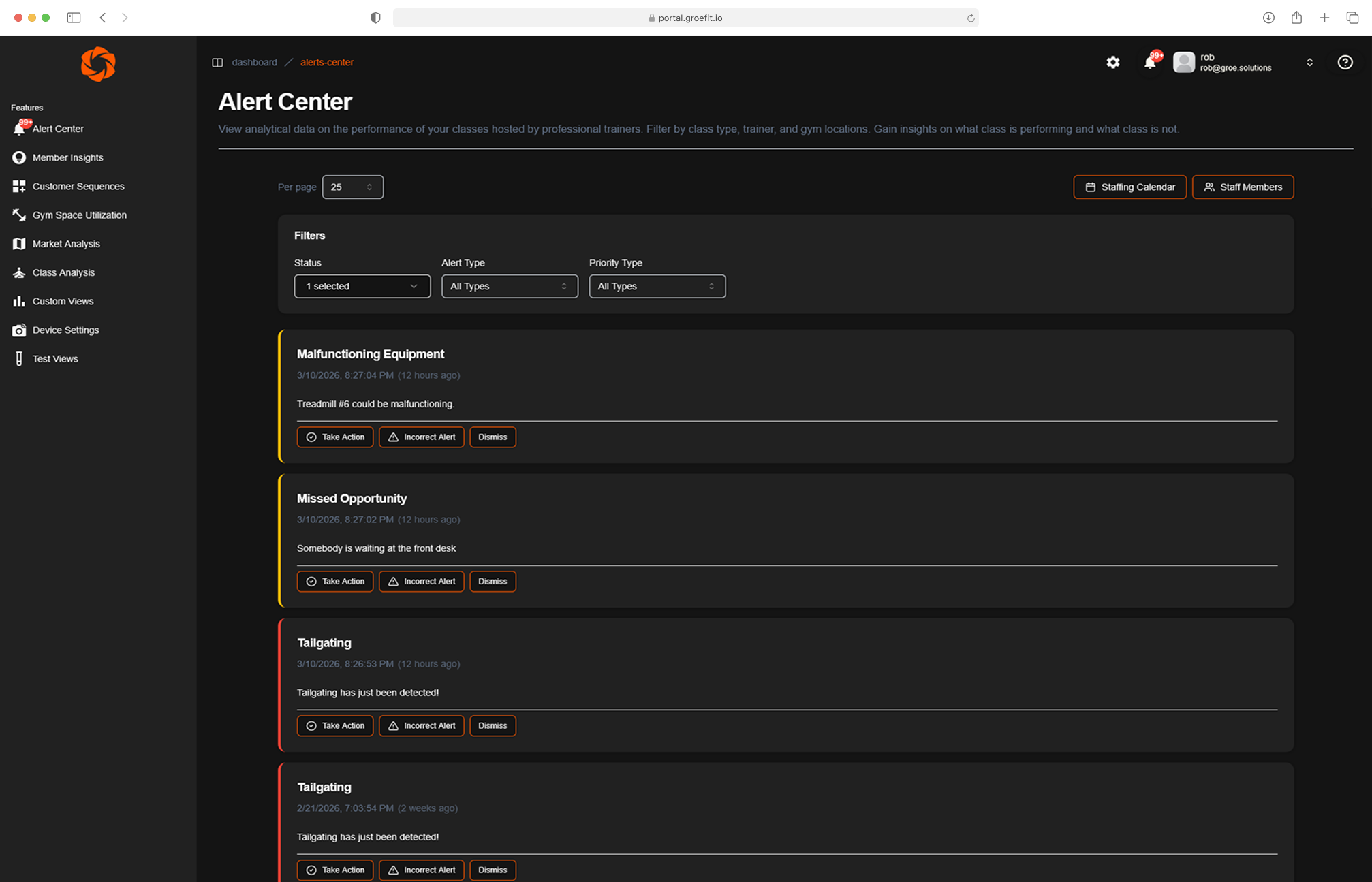
Key Areas Where Gym Operations Intelligence Creates ROI
Operational analytics impact several critical parts of the gym business.
Increased Member Retention
Retention is one of the most powerful drivers of gym profitability.
Acquiring a new member often costs significantly more than retaining an existing one.
By analyzing member engagement patterns and facility usage trends, Gym Operations Intelligence helps operators identify potential retention risks early.
For example:
- declining attendance
- reduced workout duration
- congestion-related frustration
Predictive insights allow operators to intervene before cancellations occur.
We explored this concept further in:
➤ How to Identify At-Risk Gym Members Early
Reducing churn even slightly can produce significant long-term revenue gains.
Higher Revenue Per Square Foot
Gym floor space is one of the most valuable assets a fitness operator owns.
Yet many facilities allocate space inefficiently due to limited usage insights.
Space utilization analytics allow operators to see exactly how each zone performs.
Examples include:
- cardio areas
- free weight zones
- functional training spaces
- group training areas
This enables gyms to redesign layouts, relocate equipment, or repurpose underperforming zones.
➤ Learn more in Gym Space Utilization Explained
Optimizing floor space often increases the number of members a gym can serve without expanding the facility.
Improved Labor Efficiency
Staffing is one of the largest operating expenses for gyms.
Without data-driven scheduling, gyms often:
- overstaff during slow periods
- understaff during peak hours
Operational analytics reveal when facilities experience the highest traffic levels.
This allows operators to align staffing schedules with actual demand patterns.
Better staffing alignment improves both payroll efficiency and member experience.
Smarter Equipment Investments
Gym equipment purchases are expensive.
Without reliable usage data, operators may invest in machines that members rarely use.
Utilization insights allow operators to analyze which equipment generates the most activity.
This helps answer important questions such as:
- Should we add more squat racks?
- Are treadmills underused?
- Are functional training zones growing in demand?
Data-backed decisions help ensure that equipment investments produce maximum value.
Better Peak-Hour Management
Overcrowding during peak hours can damage the member experience.
Members who frequently encounter:
- long equipment wait times
- congested zones
- crowded workout areas
are significantly more likely to cancel their memberships.
Operational analytics help operators identify peak-hour traffic patterns and redesign layouts or schedules to improve flow.
Predictive insights also help operators anticipate congestion before it becomes a problem.
➤ Explore predictive tools for gyms
Data-Driven Multi-Location Strategy
For multi-location fitness brands, Gym Operations Intelligence provides a powerful strategic advantage.
Operators can compare performance across locations to identify:
- top-performing layouts
- high-engagement programming
- staffing best practices
- equipment demand patterns
This enables operators to scale successful strategies across multiple facilities.
Unified data platforms make this visibility possible.
➤ Learn more about Unified Operations and Member Data
Measuring the ROI of Gym Operations Intelligence
While benefits vary across facilities, operators often see improvements in several measurable areas.
Common performance improvements include:
- increased member retention rates
- improved utilization of gym floor space
- reduced staffing inefficiencies
- better equipment investment decisions
- improved peak-hour experience
These operational improvements ultimately lead to stronger financial performance.
Even modest improvements in retention or efficiency can create substantial ROI over time.
The Future of Data-Driven Gym Operations
As competition in the fitness industry increases, operators are searching for ways to differentiate their facilities.
Operational intelligence is becoming a key competitive advantage.
Gyms that leverage real-time analytics and AI insights will be better positioned to:
- improve member experience
- operate more efficiently
- scale across multiple locations
- maximize facility performance
Meanwhile, gyms that continue operating without operational visibility may struggle to keep pace.
Final Thoughts
Gym Operations Intelligence represents a major shift in how fitness facilities operate.
Instead of relying on assumptions, operators can use real data to guide decisions about space, staffing, equipment, and retention strategies.
The result is measurable ROI through improved efficiency, stronger member engagement, and better use of facility resources.
For gyms focused on long-term growth, operational intelligence is quickly becoming a critical business tool.