
The Next Generation of Smart Gyms

The Next Generation of Smart Gyms: AI and Data Insights
The fitness industry is entering a new era. The next generation of smart gyms is emerging across gyms in the US and the broader gyms of America.
Over the past decade, technology has transformed how people track workouts, monitor health metrics, and engage with fitness content. Wearables, connected equipment, and mobile fitness apps have become common tools for gym members. This evolution sets the stage for AI, data, and gym operations intelligence to inform every future workout.
But the next wave of innovation goes far beyond personal fitness tracking, shaping future fitness experiences at scale.
The new smart gyms (often called an AI gym) use artificial intelligence, computer vision, and data analysis. They improve how gyms run and how people enjoy their workouts.
These technologies are enabling gyms to become data-driven environments where operators can understand member behavior, improve facility efficiency, and deliver better fitness experiences—essentially unifying AI, data, and gym operations intelligence into daily decision-making.
Key Takeaways
Smart gyms fuse AI, computer vision, connected equipment, and unified data to shift fitness from personal tracking to facility-wide operational intelligence. By analyzing attendance, equipment utilization, and traffic flows, operators optimize layouts, staffing, programming, and investments while proactively reducing churn. Integrated platforms and real-time computer-vision insights create a single source of truth that improves efficiency, member experience, and revenue per square foot. Early adopters are positioned for advances like AI coaching, adaptive environments, and automated recommendations.
Summary
Smart gyms use AI, cameras, connected machines, and data systems to improve how they operate. They look at things like how many people come in, how often equipment is used, and where people move around. This helps gym managers make better choices about space, staff, programs, and spending. It also helps them predict if members might leave, which can help keep them. With real-time data, gyms can see how their facilities are used and make decisions to improve efficiency and member satisfaction. Gyms that start using these tools see benefits like better member retention, more income per space, and better staffing. They are also ready for new developments like AI coaching and changing environments. These insights apply to everything from connected cardio to strength training gym machines and other working out machines used on busy floors.
What Is a Smart Gym?
A smart gym is a fitness facility that integrates technology into its operations, equipment, and member experience. In practice, this creates a computer fitness layer that augments traditional systems with real-time, actionable insights.
Instead of relying solely on traditional gym management systems, smart gyms use technology to collect and analyze operational data in real time.
Examples of smart gym technologies include:
- connected fitness equipment and working out machines
- wearable integration
- AI-powered analytics platforms
- computer vision monitoring
- automated member engagement tools
Together, these technologies create a connected ecosystem that helps operators run facilities more efficiently while improving the member experience.
The Evolution of Fitness Technology
Fitness technology has evolved significantly over the years.
Early gym technology primarily focused on membership management and billing systems.
Later innovations introduced:
- fitness tracking apps
- wearable devices
- connected cardio equipment
- online training platforms
Today, the focus is shifting toward operational intelligence and AI-powered insights. What used to be fragmented computer fitness dashboards is giving way to unified, real-time views of the entire facility.
We discussed the industry's historical data limitations in:
👉 Why the Fitness Industry Is Behind in Data
Modern smart gyms are now addressing these limitations by collecting and analyzing operational data across the entire facility.
AI-Powered Gym Operations
Artificial intelligence is becoming one of the most powerful technologies in modern fitness facilities.
AI systems can analyze operational data to uncover patterns that help operators improve efficiency and member satisfaction.
For example, AI can analyze:
- member attendance patterns
- equipment usage trends
- facility traffic flows
- peak-hour congestion
- engagement levels
This enables operators to make smarter decisions about staffing, programming, and facility layouts.
AI is also playing a major role in predicting member churn and improving retention. These capabilities are already being piloted by top gyms in the United States and the largest gym chains in the US.
👉 Learn more in
How AI Can Reduce Gym Membership Churn
Computer Vision and Facility Insights
Computer vision is another major innovation shaping smart gyms.
Using cameras and AI algorithms, computer vision systems can analyze how members move through the gym and interact with equipment. Operators can also generate 3D gym heatmaps to visualize movement, dwell time, and congestion in near real time.
This technology can provide insights such as:
- zone utilization patterns
- equipment popularity
- peak-hour traffic flow
- congestion points
Instead of relying on manual observation, operators gain accurate, real-time visibility into facility usage.
👉 Learn how this works with
Data-Driven Gym Layouts
Smart gyms use facility analytics to optimize their physical spaces.
Traditional gym layouts often rely on assumptions about how members use equipment.
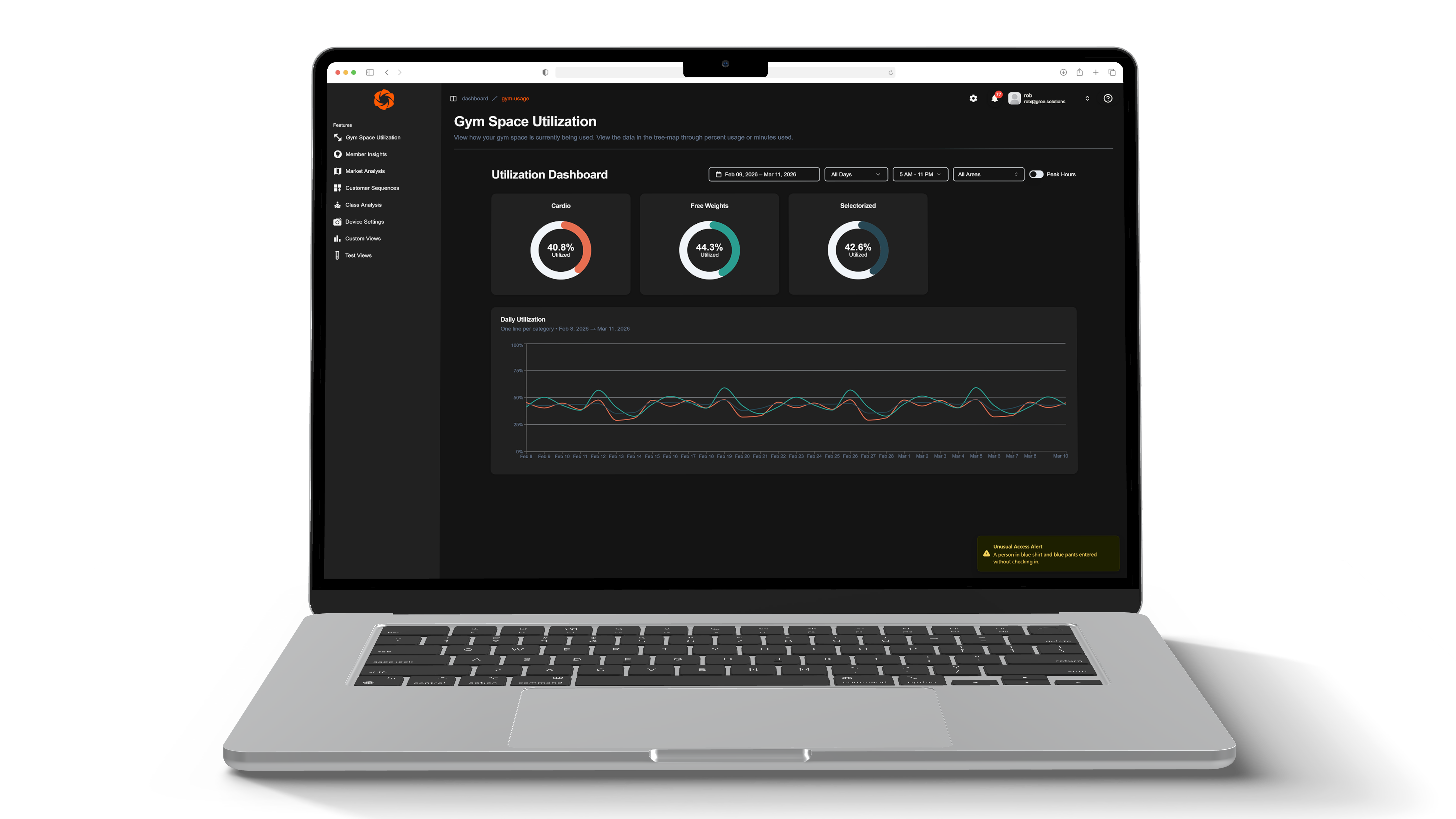
However, utilization analytics reveal exactly how each area of the gym performs.
For example, operators may discover:
- underused cardio areas
- overcrowded strength zones
- growing demand for functional training
With these insights, gyms can redesign layouts to improve both efficiency and member experience. Findings often show when dedicated machine gym sections or a full gym machine lineup should be rebalanced or relocated to reduce bottlenecks.
👉 Explore this concept in
Gym Space Utilization Explained
Predictive Analytics for Member Retention
Smart gyms also use predictive analytics to understand member behavior and identify potential retention risks.
AI models can analyze patterns such as:
- declining attendance
- reduced workout duration
- decreased facility engagement
By detecting these signals early, operators can intervene before members cancel.
👉 Learn more in
How to Identify At-Risk Gym Members Early
This proactive approach allows gyms to build stronger relationships with members and reduce churn.
Integrated Data Platforms
One of the biggest challenges in gym operations has historically been fragmented data systems.
Many gyms use separate platforms for:
- membership management
- access control
- scheduling
- marketing
- billing
Smart gyms solve this problem by integrating operational and member data into a unified platform.
This creates a single source of truth for gym operations.
Learn how unified systems work
Power the Next Generation of Smart Gyms
The Business Benefits of Smart Gyms
Smart gym technologies are not just about innovation---they deliver measurable business benefits.
These benefits include:
Improved Member Retention
Better operational insights help operators address problems before members become dissatisfied.
Higher Revenue Per Square Foot
Utilization analytics help gyms optimize facility layouts and reduce wasted space.
Better Staffing Efficiency
Data-driven scheduling aligns staffing levels with real member traffic patterns.
Smarter Equipment Investments
Operators can purchase equipment based on actual demand rather than assumptions.
These improvements ultimately contribute to stronger financial performance.
We explored this concept further in:
👉 The ROI of Gym Operations Intelligence
What the Future of Smart Gyms Looks Like
The next generation of smart gyms will likely incorporate even more advanced technologies.
Future developments may include:
- AI-powered coaching systems
- automated workout recommendations
- adaptive training environments
- advanced member engagement tools
- real-time facility optimization
Expect seamless links between the club floor and the fitness home gym, including smarter gym machines home that synchronize training, recovery, and progress across contexts. This trajectory outlines what future fitness looks like, shapes each future workout, and signals where fitness technology is heading over the next decade.
As technology continues to evolve, gyms will become increasingly intelligent environments that respond dynamically to member behavior.
Operators who adopt these technologies early will gain a competitive advantage in an increasingly data-driven fitness industry.
Final Thoughts
Smart gyms represent the future of the fitness industry.
By combining artificial intelligence, computer vision, and operational analytics, gyms can better understand how their facilities operate and how members engage with their workouts.
These insights allow operators to make smarter decisions about space, programming, staffing, and member engagement.
For fitness businesses looking to improve efficiency and deliver better experiences, smart gym technologies are quickly becoming an essential part of modern gym operations and the broader arc of AI, data, and gym operations intelligence.
Q&A
Question: What problems do smart gyms solve that traditional systems couldn't? Short answer: Traditional gyms struggled with fragmented data across membership, access control, scheduling, marketing, and billing, making it hard to see how facilities were truly used. Smart gyms unify these sources and layer in connected equipment, wearable data, AI analytics, and computer vision to create a single source of truth. This enables real-time visibility into attendance, equipment utilization, and traffic flows, so operators can make informed decisions instead of relying on assumptions.
Question: What data signals power AI-driven decisions in smart gyms? Short answer: Smart gyms analyze attendance patterns, equipment usage trends, zone utilization, traffic flows, peak-hour congestion, engagement levels, and even workout duration. These signals come from connected equipment, wearables, access logs, and computer vision. Together, they inform staffing schedules, programming, floor layouts, and churn risk prediction in an AI gym context.
Question: How do utilization analytics improve layouts and capital spending? Short answer: By showing exactly how spaces and equipment are used, utilization analytics reveal underused cardio areas, overcrowded strength zones, and rising demand for functional training. Operators can redesign layouts, rebalance equipment, repurpose space, and time programming to match real demand---leading to higher revenue per square foot and smarter, data-backed equipment investments.
Question: How do smart gyms proactively reduce churn? Short answer: Predictive models flag early risk indicators---such as declining attendance, shorter workouts, and reduced engagement. With these signals, operators can intervene before cancellations with targeted outreach, adjusted programming, or personalized recommendations, strengthening member relationships and improving retention.
Question: What business outcomes and future capabilities can adopters expect? Short answer: In the near term, gyms see higher member retention, increased revenue per square foot, better staffing efficiency, and more effective capital allocation. Longer term, unified data and AI pave the way for AI-powered coaching, automated workout recommendations, adaptive training environments, advanced engagement tools, and real-time facility optimization---delivering durable competitive advantage.